
- Roofing Guidance
- Roof Systems
White EPDM: The Reflective Option Most Bids Skip Past
Most EPDM installed in this region is black, and most contractors quote it that way by default because it's the version they stock and the version they're fastest at installing. White EPDM exists, performs differently, and is worth a real conversation before a bid gets signed, not a footnote that gets skipped because it's less familiar to the crew doing the estimate.
What Makes White EPDM Different
White EPDM isn't a separate rubber compound from black EPDM. It's typically produced with a white or light-colored surface, often through a coextruded or laminated finish, sometimes marketed under fire-retardant or reflective product lines by the same manufacturers that sell the standard black sheet. The rubber underneath behaves the same way structurally and handles the same movement and flexibility that makes EPDM useful on older, less stable decks. The surface finish is what changes.
That surface finish changes how the roof absorbs solar heat, which matters a lot in Ogden's climate, where summer roof surface temperatures on a black membrane can run well above ambient air temperature while a white membrane stays closer to it.
Cooling Load and Rooftop Equipment Life
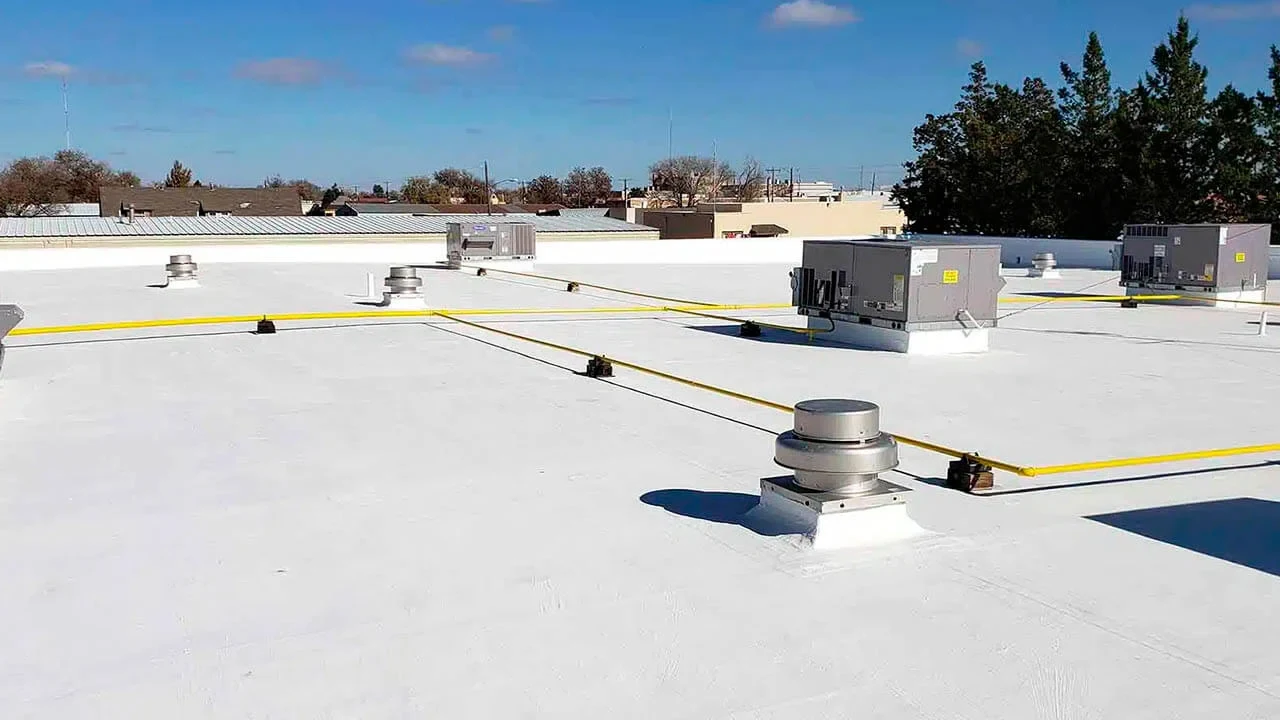
Buildings with conditioned space directly under the roof deck - offices, showrooms, any manufacturing area with process cooling - see a real difference in summer cooling load between black and white membrane. Rooftop condensing units and compressors also run in a hotter microclimate sitting on a black roof than a white one, and equipment life shortens when it's working against a hotter ambient temperature at the roof surface all summer.
For a warehouse with minimal conditioned space and rooftop units set on curbs well above the membrane, the reflective benefit matters less. For an office-warehouse combo building or anything with a shallow curb height close to the membrane surface, it's worth running the numbers.
Winter Tradeoffs Nobody Mentions
The flip side that reflective-membrane sales pitches tend to leave out: a white roof also melts snow slower than a black one under winter sun, because it isn't absorbing as much solar heat. On a building where slow, even snow melt is actually preferable to rapid melt-refreeze cycling at drains, that's a genuine advantage. On a building where owners want snow off the roof faster to reduce load duration, it's a tradeoff worth discussing rather than assuming reflective is automatically the better choice year-round.
We walk through both seasons with an owner before recommending white over black, because the annual energy savings from summer reflectivity has to be weighed against how the building actually uses its roof through a full Wasatch Front winter.
Fire-Retardant and Coated Variants
Some white EPDM products are sold specifically as FR-rated membrane for roofs with code requirements around fire classification, which matters on certain occupancy types and roof assemblies. Others are standard EPDM with a reflective coating applied either at the factory or in the field after installation. Those are different products with different long-term maintenance needs - a factory-applied reflective layer tends to hold up longer than a field-applied coating that needs periodic recoating to maintain its reflectivity.
A bid that just says "white EPDM" without specifying which version is being installed is leaving out a detail that affects how the roof performs in year eight or ten, rather than just on installation day.
- Whether the white surface is a factory laminate or a field-applied coating
- Fire classification rating if code requires it for the building's occupancy
- Recoating interval and cost if the reflective layer is coating-based rather than laminated
- Seam splice method, same tape-versus-liquid consideration as black EPDM
- Curb height and rooftop unit exposure to assess how much the reflectivity actually helps
- Winter snow-melt behavior and whether slower melt suits the building's drainage
Where We Actually Recommend It
White EPDM makes the most sense on buildings with real conditioned space under a low-slope roof, older structural decks that benefit from EPDM's flexibility but where the owner also wants a reflectivity upgrade over the historical black sheet, and re-cover projects where the existing roof was black and heat-soaked and the owner has noticed the cooling cost difference firsthand. It's a narrower recommendation than it sounds from a general sales pitch, and that's on purpose - reflective membrane is a real tool for specific building types, not a universal upgrade every roof needs.
On a straightforward unconditioned warehouse with the rooftop units mounted on tall curbs, we usually steer owners back to standard black EPDM and put the budget difference toward better insulation or a heavier membrane gauge instead.
Questions on White EPDM
Is white EPDM more expensive than black?
Yes, typically a moderate premium over standard black membrane, more if it's a fire-retardant or specialty laminated version rather than a basic reflective sheet.
Does white EPDM stay reflective over time?
A factory-laminated white surface holds its reflectivity better over the roof's service life than a field-applied coating, which will need periodic recoating and cleaning to maintain its reflective value.
Can black EPDM be converted to white later with a coating?
Yes, an elastomeric or acrylic coating can be applied over sound black EPDM to add reflectivity without full replacement, though it's a maintenance item that needs reapplication on its own schedule.
Does white EPDM affect snow load differently than black?
It doesn't change the membrane's structural role, but it does change how fast snow melts off the roof under sun exposure, which affects how long load sits on the structure during a given storm cycle.
Is white EPDM worth it on a building without much conditioned space?
Usually not as a priority. The energy savings come from reduced cooling load under the roof, and a mostly unconditioned warehouse won't see the same return that an office-warehouse or occupied building would.
Questions About White EPDM Roofing in Ogden, UT
Ready to Review the Roof?
Roof Systems
White reflective EPDM for Ogden commercial roofs: cooling-load tradeoffs, FR-coated membrane options, and where reflective rubber beats black membrane.
Plan the Next Step